
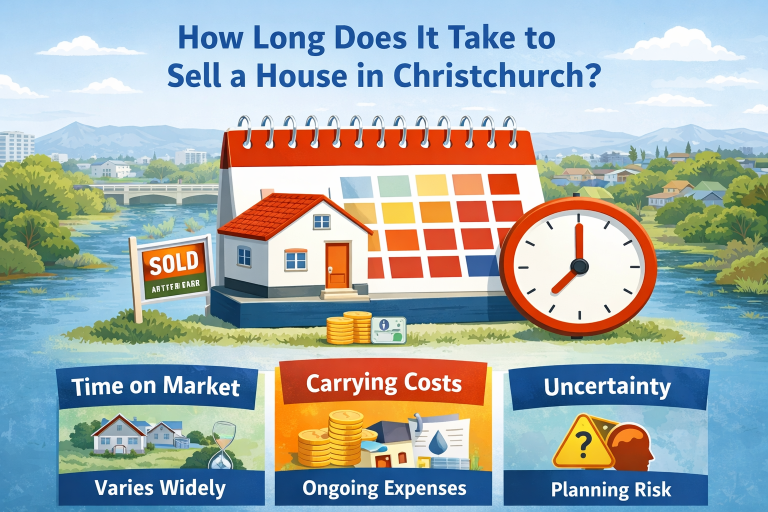
Time as a Core Selling Variable
Most homeowners ask how much their property is worth. Fewer ask how long it is likely to take to sell — yet time is one of the most influential variables in the selling decision.
In Christchurch, time on market varies widely depending on location, property type, pricing accuracy, and broader market conditions. Understanding this variability is essential for managing risk and expectations.
Typical Timeframes — and Why They Vary
In stable market conditions, a well-priced property in Christchurch may sell within several weeks. In softer or uncertain markets, that same property can remain listed for months.
Key drivers of time on market include:
- Accuracy of initial pricing
- Buyer demand in the specific suburb
- Property condition and presentation
- Interest rate and lending environment
Time is not evenly distributed. A property that does not attract early interest often experiences longer overall selling periods.
The First Few Weeks Matter Disproportionately
Buyer activity is typically highest shortly after a listing goes live. This period shapes:
- Perceived market value
- Negotiation leverage
- Future buyer expectations
If a property fails to gain traction early, price adjustments may be required later, often after weeks or months of exposure.
This dynamic explains why time and price are tightly linked.
Carrying Costs During the Selling Period
Every week on the market has a financial impact. Depending on the property, this may include:
- Mortgage interest
- Council rates
- Insurance
- Maintenance and utilities
These costs are often overlooked when sellers focus exclusively on headline sale price. A slightly higher price achieved after a long campaign may result in a lower net outcome once time is accounted for.
Uncertainty as a Cost
Time on market is not just a financial issue. Extended selling periods introduce uncertainty that affects planning and decision-making, particularly for sellers who need to:
- Coordinate a purchase
- Finalise a separation or estate
- Relocate for work or family reasons
This uncertainty is rarely priced explicitly, but it shapes how sellers experience the process.
When Speed Matters More Than Optimisation
For some homeowners, maximising price is the priority. For others, clarity and certainty are more valuable.
Time-sensitive situations include:
- Financial pressure
- Vacant or non-performing properties
- Health or family transitions
In these cases, understanding realistic timelines helps avoid decisions that look optimal on paper but fail under real-world constraints.
Summary: Selling Time as a Decision Input
How long it takes to sell a house in Christchurch is not a fixed answer but a range shaped by market conditions and seller choices.
A rational approach treats time as an input to the decision, not a by-product of it.
For a broader explanation of how time, cost, and uncertainty interact when selling, see our guide on selling my house in Christchurch.